When evaluating enterprise workforce management software, organisations should assess areas like requirements, compliance capabilities, integration needs, analytics and long-term scalability.
Have you made the decision to switch to an enterprise workforce management software that fully supports how you operate?
A workforce management (WFM) solution is critical to efficiently run your organisation. Changing it is no small task, so it’s important to take time to evaluate your options.
For global organisations, workforce management presents additional complexity. Supporting employees across multiple countries, languages and time zones requires efforts to balance global consistency with local flexibility. Unique operational requirements and regulatory obligations demand solutions that can adapt to regional needs whilst maintaining enterprise-wide visibility and control.
With all that in mind, it’s important to carefully evaluate your options.
Use this guide to help you identify how your needs have evolved in the context of the business challenges, regulatory changes and worker expectations you’ve encountered:
- Examine your operational and people-focused requirements
- Understand the implications of implementing a new solution
- Select a solution that improves performance now and adapts moving forward
The essential guide to selecting enterprise workforce management software
Use this guide to select an enterprise workforce management solution that best meets the needs of your organisation.
Reasons for changing your workforce management software

Evolving needs
Your needs are no longer what they were a few years ago given the pace of change in regulations and worker demands
Agile scalability
Your manual processes and homegrown applications don’t enable rapid adaptability, automation or global scale
Product sunset
You’re being forced to select a new solution because your legacy application provider is sunsetting their current product
Resources for evaluating vendors and solutions
Components of an advanced enterprise workforce management solution
A fully modern workforce management system provides a comprehensive set of capabilities for improving time management, employee experience and operational excellence.
Labour optimisation
- Optimises workforce utilisation by matching the right people and skills to demand through intelligent labour planning
- Reduces manual effort through automated approvals, overtime and no-show alerts and qualified worker assignment to open shifts
Operational efficiency and productivity
- Provides labour forecasting and time-tracking technology that aligns company requirements with worker data, such as personal leave, availability hours and skill level
- Optimises staffing outcomes while delivering benefits, such as improved safety and flexible rostering for managers and their teams, integrated into the flow of work
Compliance
- Simplifies compliance across multiple countries no matter how unique the pay rules, labour regulations, rosters or policies
- Allows people to adapt rapidly to changing rosters while meeting federal, state and trade union compliance requirements
Data-based decision making
- Offers predictive analytics and insights to take proactive actions
- Allows for the monitoring, comparison and assessment of data generated across worker populations, locations and divisions to discover best practices and accelerate adoption
Secure data and privacy protection
- Offers global protection against data security breaches
- Includes multiple co-located global Saas facilities with primary and disaster recovery data centers and data encryption to safeguard information from unauthorised access
Automation and exception management
- Goes beyond time and attendance, including overtime distribution, perfect-attendance bonuses, fatigue management and automated alerts that prevent clock-ins with expired certifications
Integrations with ERP and HCM solutions
- Enables data sharing between the workforce management solution and other business-critical systems, including HCM and ERP platforms
- Reliably supports payroll providers, core HR solutions and operations
How to evaluate artificial intelligence (AI) for workforce management
As adoption of AI accelerates in workforce management, prioritising the right Al agents is critical for achieving successful returns. According to Gartner®, Al adoption in WFM is gaining traction as organisations seek to address labour roster optimisation and forecasting accuracy.
When evaluating any Al tool, consider the following:
Time agents
- Automate entry and approval, and anomaly detection for missed punches or exceptions
- Reduce manager and employee admin tasks
- Improve payroll precision and labour cost allocation
Shift agents
- Automatically identify best workers for open shifts and swaps
- Optimise rosters for business need, coverage and reduced OT cost
- Reduce manager effort
Leave agents
- Evaluate PTO requests with minimal business impact
- Simplify access to leave entitlements
- Improve employee experience and compliance
Policy agents
- Guide practitioners on policy configuration and downstream impact
- Stay compliant with laws and regulations
- Provide people the support they’re entitled to
Analytics agents
- Forecast labour demand, supply and attrition
- Auto-generate dashboards and insights
- Enable proactive workforce planning
Technology that doesn’t force you to compromise
Built with a deep understanding of our clients’ technology environments, ADP WorkForce Suite is available unified with ADP’s human capital management (HCM) platform and integrates with any other HCM/payroll, so you don’t have to compromise.

Unified experience with ADP HCM solutions
ADP WorkForce Suite is part of ADP’s HCM ecosystem that’s built to work together. With one login, one interface and one shared navigation across time, pay and HR, ADP WorkForce Suite provides a single source of truth for your workforce data. The result is an easier, smarter and more human experience for managers and their teams everywhere.
Our unified offering
ADP WorkForce Suite works seamlessly inside the ADP HCM ecosystem for everything you need to manage your workforce.

Certified integrations with ERP solutions
ADP WorkForce Suite is designed to work within a large ecosystem of technology partners. You can easily share data between ADP WorkForce Suite and your other business-critical systems, including HCM and ERP platforms, and hundreds of best-of-breed solution providers for payroll, core HR, operations, access control and more.
Our technology partners
ADP WorkForce Suite integrates with leading HCM and ERP systems for an all-in-one solution.


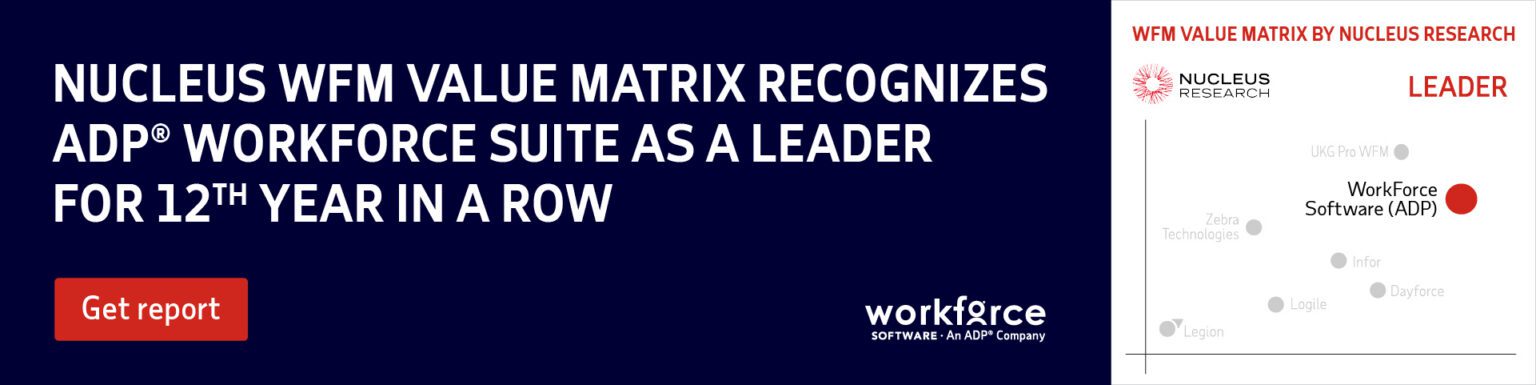
Work with the leader in enterprise workforce management
Build your business case
Our client value experts will work with you and your key stakeholders to make a data-driven case for change.
Get Value Assessment
Send us your RFP
If you’re clear about your needs and goals, we look forward to designing a solution that meets all your requirements.
Submit RFP
Frequently asked questions about ADP WorkForce Suite
What is enterprise workforce management software?
- Enterprise workforce management software is a suite of tools that help large organizations manage their workforce more effectively. It combines capabilities such as:
- Rostering
- Time and attendance tracking
- Labour forecasting and planning
- Leave and absence management
- Workforce compliance
- Workforce analytics and reporting
- Organisations use enterprise workforce management software to optimise staffing, reduce labour costs, improve productivity, maintain compliance and deliver a better employee experience.
Why chose ADP WorkForce Suite for enterprise workforce management software?
- ADP WorkForce Suite is built for global organisations that need deep configurability, multi-country compliance and a platform that scales with complex operations. With prebuilt templates for 41 countries, the ability to support operations in more than 100 nations, flexible integration with leading HCM and ERP systems and multiple implementation options, including ADP’s in-house unparalleled delivery, ADP WorkForce Suite gives enterprises the confidence, automation and agility they need to manage today’s workforce complexity.
What should be included in workforce management requirements gathering?
- Workforce management requirements gathering is the process of documenting an organisation’s business, workforce, compliance and technology needs before selecting or implementing a workforce management solution. It should include rostering, time and attendance, leave management, labour forecasting, compliance, reporting, integrations, user experience and scalability requirements to help ensure the solution supports both current and future workforce needs.
Is HCM integration important when selecting workforce management software?
- HCM integration is important when selecting workforce management software because it connects workforce data, HR processes and payroll systems. A strong integration helps organisations reduce manual work, improve data accuracy, streamline payroll and compliance processes, gain better workforce insights and deliver a better employee experience.