
Blog summary: Based on an expert-led webinar, this blog covers how modern workforce management strategies can help you scale more efficiently and effectively in highly unionised environments.
Highly unionised operations are the norm for many companies. Most will be familiar with the challenges behind juggling many unique agreements, especially those that grow as your business scales. Fortunately, there are ways to simplify the process without stopping growth.
In this Workforce Excellence webinar covering workforce management strategies for highly unionised environments, Jen Blaharski, solutions consultant, WorkForce Software, an ADP company, and Tyler Nelson, WorkForce Software practice lead, AspireHR, shared their insights. They also went through a demonstration of the conventional approach and a demonstration of what’s possible with enterprise workforce management software.
Let’s review what they covered in this webinar.
Automation and efficiency in highly unionised environments
The discussion kicked off with a statement: Automation is a key element to getting the most out of highly unionised, complex organisations.
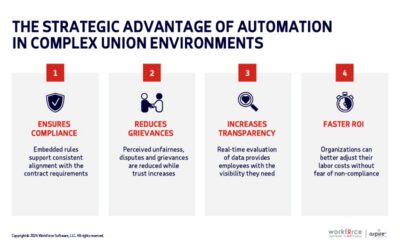
When used correctly, automation is a gamechanger. Carefully set rules help support compliance and efficiency whilst reducing the risks involved with manual actions. It can also increase transparency through on-demand reports and audits.
If you want to optimise your return on investment (ROI) whilst remaining compliant with trade union agreements, automation is your best bet. However, the operations behind it are just as essential as the concept itself. A conventional approach might work for some, but those working in highly unionised environments might need a more scalable strategy.
What’s wrong with the conventional approach?
In the conventional approach to workforce management automation, each trade union gets its own policies in the system. It’s a logical approach given that trade unions may frequently join, leave or renegotiate their terms. Traditionally, you’d create those policies with the help of templates that stand alone and don’t impact any other policies.
But here’s where it gets difficult: that approach isn’t necessarily scalable. When you make a template for every single trade union’s unique rules, you’re also copying over the same rule policies every time. Many trade unions have the same policies when it comes to common factors like holidays. However, even these must be copied every time, leading to an increasingly unmanageable policy set to deal with.
More agreements mean more templates, more records to keep straight and more repetitive rules to keep track of. The conventional strategy might be functional on a small scale, but it tends to be a poor fit for those seeking to master global workforce complexity at scale.
Modern workforce management for scaling multi-trade union settings
Introducing a more scalable solution allows for greater efficiency when updates are needed without missing any critical rules or nuances. Tyler demonstrated one method using the labour distribution tables within ADP WorkForce Suite.
Labour distribution tables are expansive data tables that you can edit and perform lookups on. Because they’re wildly customisable, you can create a system that accounts for every detail and keeps it all organised. Plus, it’s a system admin feature, meaning you don’t have to be a certified professional to make changes or access information.
Tyler demonstrated its functionality with a highly unionised use case managing over 2,000 policies whilst discussing the benefits of this more scalable strategy:
- Automating pay and business rules helps support compliance
- Requirements stay consistently aligned
- Easy access to audits increases trust and transparency
- Real-time data is readily available for every person that needs it
- Better ROI from strategies tailored to your specific business and growth needs
Want to learn more? Watch the webinar on modern workforce management and labour distribution tables today to get the full story, including typical challenges and a Q&A session.