
Summary: This blog explores the trends reshaping workforce management in 2026, including evolving labour regulations, global workforce operations, worker expectations and mobile-first experiences. Recognised as a leader in the 2026 Nucleus Research Workforce Management (WFM) Technology Value Matrix for the 12th consecutive year, ADP WorkForce Suite demonstrates how modern workforce management solutions can help businesses improve agility, reduce risk and turn workforce complexity into a competitive advantage.
By: The WorkForce Software team at ADP
Table of contents:
- Can a workforce management system support global complexity?
- Turning complex needs into workforce management success
- The Nucleus WFM Value Matrix highlights ADP WorkForce Suite functionality
- Connected workforce management at enterprise-scale
- WorkForce Spark: Accelerating time to value
- Leadership built on solving real workforce challenges
Selecting the right workforce management technology has never been more critical for large, complex organisations. The 2026 Nucleus Research workforce management (WFM) technology value matrix, which assesses providers on functionality and usability, offers a valuable benchmark for organisations evaluating workforce management solutions. In this year’s report, ADP® WorkForce Suite was recognised as a functionality leader for the 12th consecutive year.
For enterprise organisations, the requirements for successful workforce management have become far more complex than tracking hours and building rosters. Today’s workforce leaders are asked to navigate evolving labour regulations, diverse workforce models, rising worker expectations and increasingly global operations, all whilst maintaining productivity and controlling costs. This WFM value report highlights the growing importance of robust workforce management capabilities in today’s business environment and offers.
Can a workforce management system support global complexity?
Compliance complexity is a familiar challenge, especially for enterprises that operate on a global scale. Balancing requirements across regions and jurisdictions and managing varying labour agreements can serve as a barrier to supporting a workforce that increasingly expects flexibility, transparency and mobile-first experiences. At the same time, leadership teams are looking to workforce data for strategic insights that can improve operational performance and inform business decisions.
These pressures have expanded the role of workforce management beyond traditional administrative functions. WFM solutions are now expected to support workforce planning, compliance, employee engagement, labour optimisation and operational agility within a single ecosystem.
According to Nucleus Research, “organisations are increasingly focused on solutions that deliver strong functionality whilst improving usability and adoption. The rise of AI-driven insights, self-service tools and tighter integration between workforce management, HR and payroll systems reflects a broader demand for more connected and intelligent workforce operations.”
Turning complex needs into workforce management success
The Nucleus report makes clear that buyer evaluation criteria are expanding beyond the foundations of traditional workforce management requirements. Basic workforce management tools may address labour rostering or time capture, but global enterprises often require significantly deeper capabilities. They need technology that can adapt to complex business rules and automate compliance processes whilst supporting local operations across multiple regions, business units and workforce types.
This is where functionality creates measurable value. Workforce management solutions that automate compliance and support smarter rostering help organisations operate more efficiently whilst minimising administrative burden and risk. Functionality also enables scalability. As organisations grow, enter new markets or adjust workforce strategies, their workforce management systems must be able to evolve alongside them. Highly configurable platforms provide the flexibility needed to accommodate changing requirements without creating an unnecessary administrative burden.
The Nucleus WFM Value Matrix highlights ADP WorkForce Suite functionality
As workforce challenges become more complex, functionality becomes a critical differentiator.
Enterprise organisations operate in increasingly dynamic environments. Their workforce management technology must be capable of accommodating changing regulations and supporting varied workforce arrangements. Equally important is the ability to scale across regions as business needs evolve.
The ability to manage workforce complexity is one of the defining characteristics of leading workforce management solutions. ADP WorkForce Suite was purpose-built to help organisations address the realities of complex workforce operations. The solution is purpose-built to adapt to the specific needs of organisations operating across geographies, regulations and workforce models.
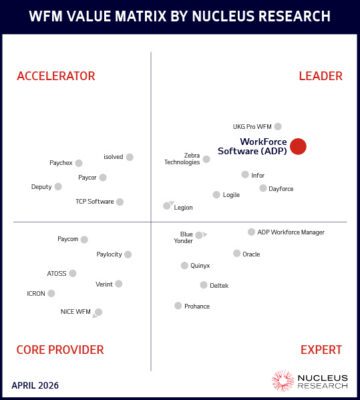
As the Nucleus report explains, a key strength of the solution is its configurable rules engine, which helps automate compliance across forecasting, rostering, time management and absence management processes. By embedding workforce policies and labour requirements directly into workflows, organisations can reduce manual effort whilst helping managers make more informed decisions. This level of adaptability is increasingly important as labour regulations continue to evolve, and organisations seek greater consistency across their operations.
Connected workforce management at enterprise-scale
Another trend shaping the workforce management market is the demand for greater connectivity. Organisations want to eliminate silos between workforce management, HR and payroll systems in order to create a more unified worker and manager experience. In this way, connected workforce management systems can improve data accuracy and reduce administrative tasks. This frees up manager time and provides more opportunities for comprehensive workforce insights.
ADP WorkForce Suite supports this need through its unified experience with ADP’s human capital management and payroll solutions. whilst also offering integration capabilities with other HCM and payroll systems. According to the Nucleus report, ADP WorkForce Suit’s API integrations enable our clients to connect existing HCM and payroll solutions. This flexibility helps organisations modernise workforce management without requiring a complete transformation of their existing technology landscape.
WorkForce Spark: Accelerating time to value
Enterprise workforce management projects have historically been associated with lengthy implementations and extensive customisation efforts. Today, organisations are looking for faster paths to value without sacrificing flexibility. That’s why preconfigured deployment options have become increasingly valuable.
To this end, The Nucleus report highlighted WorkForce SPARK, a set of pre-configured solutions built on the Suite Templates Engine to support rapid deployment. It also offers a template library that includes hundreds of parameterised capabilities supporting country- and industry-specific requirements.
Organisations can accelerate their implementation time whilst retaining the ability to adapt the solution to their unique operational needs. This approach helps organisations shorten deployment timelines whilst maintaining the configurability required to support long-term growth. The result is a faster path to workforce management modernisation and business outcomes.
Leadership built on solving real workforce challenges
Industry recognition alone does not determine the value of a workforce management solution. However, sustained recognition can provide insight into the capabilities organisations to prioritise most.
ADP WorkForce Suite’s recognition as a leader in the Nucleus Research WFM Technology Value Matrix for the 12th consecutive year reflects an ongoing commitment to helping organisations manage workforce complexity through functionality and configurability that supports opportunities for innovation.
As workforce management continues to evolve, organisations will need solutions that do more than automate individual processes. They’ll need technology capable of adapting to changing regulations, supporting diverse workforce models and connecting workforce operations across the enterprise.
The businesses that successfully turn workforce complexity into a competitive advantage will be those equipped with workforce management solutions designed to meet today’s challenges whilst remaining flexible for tomorrow’s opportunities.
Access the full 2026 Nucleus Research WFM value matrix report to learn what distinguishes leading workforce management systems.